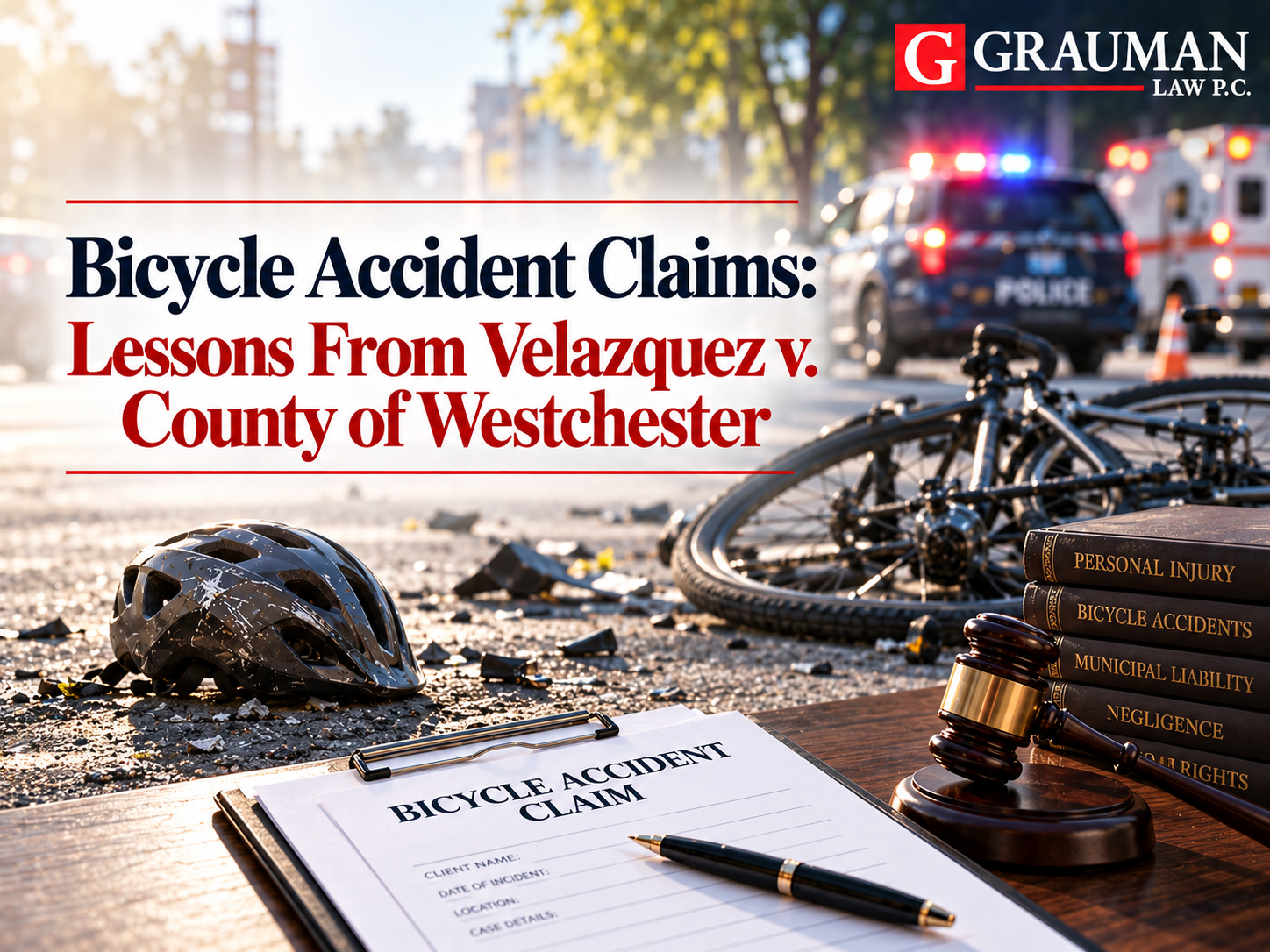
A recent New York case, Velazquez v. County of Westchester, highlights an important aspect of bicycle accident litigation: property owners and those responsible for maintaining premises may be held liable when dangerous conditions contribute to a cyclist's injuries.
The decision serves as a reminder that bicycle accident claims can extend beyond roadway negligence and may involve issues of premises liability, property maintenance, and dangerous conditions.
The Facts of the Case
In Velazquez v. County of Westchester, the plaintiff brought a personal injury lawsuit after allegedly suffering injuries while riding his bicycle near the North White Plains train station parking lot.According to the plaintiff, the accident occurred when he collided with the arm of a toll booth located within the parking facility.
The plaintiff alleged that the condition of the property contributed to the accident and sought compensation for his injuries.
The defendants moved for summary judgment, arguing that the case should be dismissed before trial. They contended that the toll booth arm was an open and obvious condition and therefore could not serve as the basis for liability.
The dispute ultimately reached the Appellate Division, which examined whether the defendants had established entitlement to dismissal as a matter of law.
Bicycle Accident Cases Are Not Always About Cars
Many cyclists are surprised to learn that a bicycle accident claim may arise even when no motor vehicle is involved.Cyclists frequently encounter hazards such as:
- Gates and barriers;
- Parking lot structures;
- Construction equipment;
- Potholes;
- Uneven pavement;
- Defective sidewalks;
- Roadway debris;
- Poor lighting conditions;
- Improperly placed signs; and
- Other dangerous property conditions.
The Velazquez case demonstrates how these issues can become central to a bicycle injury lawsuit.
Understanding the "Open and Obvious" Defense
One of the primary arguments raised by the defendants involved the legal concept of an "open and obvious" condition.Property owners frequently argue that they should not be liable for injuries caused by conditions that are readily visible.
The theory behind this defense is that individuals should be expected to observe and avoid obvious hazards.
However, New York courts have repeatedly explained that simply labeling a condition as "open and obvious" does not automatically eliminate liability.
Courts must often consider additional factors, including:
- The surrounding environment;
- Lighting conditions;
- Visibility;
- The location of the hazard;
- Foreseeable use of the property; and
- Whether the condition was inherently dangerous.
What Did the Court Decide?
The Appellate Division reversed the lower court's dismissal of the case.The court determined that the defendants failed to establish, as a matter of law, that the toll booth arm was both open and obvious and not inherently dangerous under the circumstances existing at the time of the accident.
In other words, the court concluded that factual questions remained regarding the nature of the condition and whether it presented an unreasonable danger to users of the property.
Because those issues could not be resolved solely based on the evidence presented by the defendants, dismissal was inappropriate.
As a result, the plaintiff was permitted to continue pursuing the bicycle injury claim.
Why Property Owners Have a Duty to Maintain Safe Conditions
Under New York law, property owners and those responsible for maintaining property generally have a duty to keep their premises in a reasonably safe condition.This duty may apply to:
- Parking lots;
- Commercial properties;
- Train stations;
- Shopping centers;
- Sidewalks;
- Apartment complexes;
- Public facilities; and
- Other areas where people are expected to travel.
When a dangerous condition exists and contributes to an injury, courts may examine:
- Whether the owner created the condition;
- Whether the owner knew about the condition;
- Whether the owner should have discovered it through reasonable inspection; and
- Whether reasonable corrective action was taken.
Why Visibility Alone Does Not End a Case
One of the most important lessons from Velazquez is that visibility is only one factor in determining liability.Property owners often argue that a condition was obvious and therefore not actionable.
However, courts recognize that some visible conditions can still be dangerous.
For example:
- A visible pothole may still present a hazard;
- A visible obstruction may be improperly placed;
- A visible barrier may be difficult to perceive under certain lighting conditions; or
- A visible structure may create an unreasonable risk because of its location.
Common Property Hazards That Cause Bicycle Accidents
Cyclists are particularly vulnerable to roadway and property defects because bicycles are less stable than passenger vehicles and often have limited room to maneuver.Common hazards include:
Gates and Barriers
Parking lot arms, access gates, and entry barriers can create risks when improperly maintained or positioned.Potholes and Surface Defects
Even relatively small roadway defects can cause a cyclist to lose control.Poor Lighting
Inadequate illumination can make obstacles difficult to detect.Construction Zones
Temporary barriers, debris, and equipment can create dangerous conditions.Drainage Grates and Utility Covers
Improperly maintained infrastructure may present hazards to cyclists.Debris and Obstructions
Loose materials, equipment, or objects left in travel areas can contribute to crashes.What This Means for Injury Victims
The Velazquez decision highlights the importance of conducting a thorough investigation after a bicycle accident.Potentially important evidence may include:
- Photographs of the accident scene;
- Surveillance footage;
- Maintenance records;
- Property inspection reports;
- Witness statements;
- Lighting conditions at the time of the incident; and
- Evidence identifying the parties responsible for maintaining the property.
Why This Case Matters in Queens
Queens has experienced significant growth in bicycle traffic over the past decade.Cyclists regularly travel through:
- Long Island City;
- Astoria;
- Flushing;
- Forest Hills;
- Jackson Heights;
- Sunnyside;
- Jamaica; and
- Bayside.
- Train stations;
- Parking facilities;
- Commercial properties;
- Public transportation hubs; and
- Mixed-use developments.
The legal principles discussed in Velazquez are therefore highly relevant to cyclists who suffer injuries because of dangerous conditions on public or private property.
Key Takeaways From Velazquez v. County of Westchester
The case offers several important lessons:Bicycle Accidents Are Not Limited to Vehicle Collisions
Dangerous property conditions can also cause serious cycling injuries.Property Owners May Face Liability
Those who own, control, or maintain property may be responsible when hazardous conditions contribute to an accident.Open and Obvious Does Not Automatically Mean Safe
Courts consider the surrounding circumstances when evaluating dangerous conditions.Thorough Investigation Is Essential
Identifying responsible parties and preserving evidence is often critical to a successful claim.Conclusion
The decision in Velazquez v. County of Westchester demonstrates that bicycle accident cases often involve issues far beyond motor vehicle negligence. After allegedly colliding with a toll booth arm at the North White Plains train station parking lot, the plaintiff pursued claims based on the condition of the property. The Appellate Division determined that the defendants failed to establish, as a matter of law, that the condition was open and obvious and not inherently dangerous, allowing the case to proceed.For cyclists in Queens and throughout New York, the case serves as an important reminder that dangerous property conditions can play a significant role in bicycle accidents. When hazards such as gates, barriers, poor lighting, potholes, or obstructions contribute to a crash, property owners and those responsible for maintaining the premises may face liability for resulting injuries.