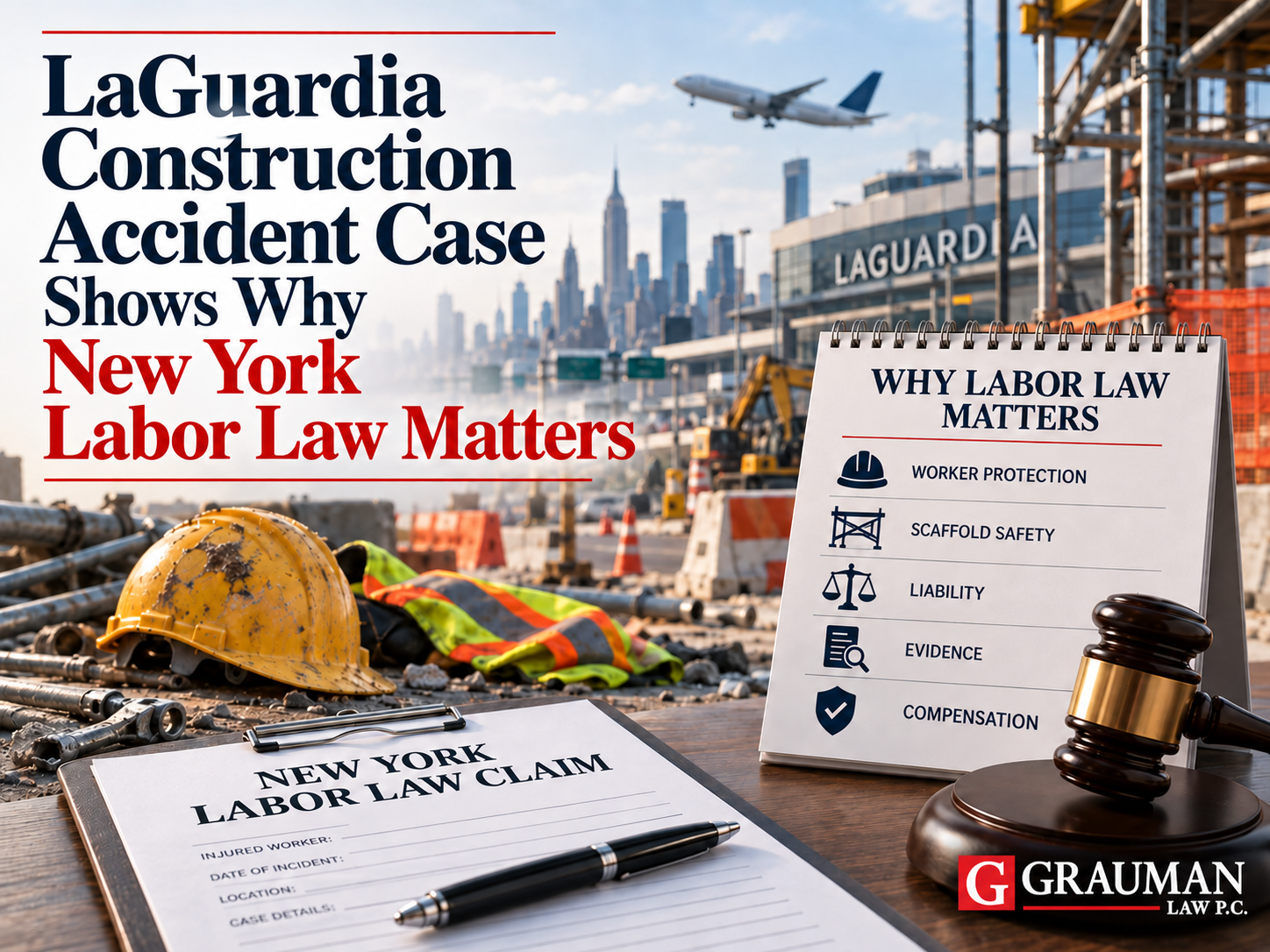
Construction work is one of the most dangerous occupations in New York. Workers regularly face hazards such as falls, falling objects, electrical risks, heavy machinery, and dangerous site conditions. Because of these risks, New York has enacted labor laws designed to protect construction workers and hold owners and contractors accountable when safety violations contribute to injuries.
A recent case, McCloskey v. Port Authority of New York and New Jersey, illustrates how these protections can come into play following a workplace accident. The case arose from a major construction project at LaGuardia Airport in Queens and serves as a reminder that injured workers may have legal rights that extend beyond traditional workers' compensation benefits.
The Facts of the Case
The plaintiff in McCloskey was working on the extensive redevelopment project at LaGuardia Airport.
According to the allegations, the plaintiff was employed by Welsbach Electric and was assigned to a night shift involving cable work in underground manholes located within the construction site.
As the shift came to an end, the plaintiff left the work area and proceeded through a section of the jobsite. He later testified that the area was poorly illuminated.
While walking, the plaintiff stepped on an object, lost his footing, and fell forward. After the incident, he observed pieces of wood scattered throughout the area where he fell.
The lawsuit named several entities involved in the project, including the Port Authority of New York and New Jersey and LaGuardia Gateway Partners as property owners, along with Skanska-affiliated entities that served as general contractors.
The plaintiff alleged that unsafe construction-site conditions contributed to the accident.
Why Construction Site Housekeeping Matters
Construction sites are constantly changing environments. Materials, tools, debris, and temporary structures are frequently moved throughout the workday.
Because of this, proper housekeeping is a critical component of workplace safety.
Hazards that may increase the risk of falls include:
- Scattered construction materials;
- Loose lumber;
- Debris left in walkways;
- Uneven surfaces;
- Temporary obstacles;
- Electrical cords; and
- Inadequate lighting.
Even experienced workers can be injured when work areas are not properly maintained.
Construction companies are expected to implement procedures that help keep passageways and work areas reasonably safe for workers moving throughout the site.
The Dangers of Poor Lighting on Construction Sites
Lighting is one of the most overlooked yet important safety measures on any construction project.
Workers rely on adequate illumination to:
- Identify tripping hazards;
- Navigate walkways safely;
- Detect changes in elevation;
- Avoid construction materials and debris;
- Operate equipment safely; and
- Maintain awareness of their surroundings.
Night-shift workers may face increased risks when temporary lighting is inadequate or when portions of a construction site remain poorly illuminated.
In the McCloskey case, the plaintiff specifically alleged that the area where he fell lacked sufficient lighting, making it difficult to see hazards in his path.
Understanding Labor Law § 241(6)
One of the central legal issues in the case involved New York Labor Law § 241(6).
This statute imposes a duty on owners and contractors to provide reasonable and adequate protection and safety for workers involved in construction, excavation, and demolition activities.
Unlike an ordinary negligence claim, Labor Law § 241(6) permits injured workers to pursue claims based upon violations of specific provisions contained in New York's Industrial Code.
When applicable safety regulations are violated and those violations contribute to a worker's injury, owners and contractors may face liability.
Importantly, these claims are often brought in addition to workers' compensation benefits.
What Did the Court Consider?
In McCloskey, the plaintiff sought partial summary judgment under Labor Law § 241(6).
The plaintiff argued that construction-site safety violations contributed to the accident and that the evidence supported liability under the statute.
The litigation focused on whether conditions at the worksite—including the alleged presence of scattered wood and inadequate lighting—violated applicable safety requirements and contributed to the plaintiff's fall.
As with many Labor Law cases, the court's analysis centered on the specific circumstances surrounding the accident and whether the alleged safety violations were sufficient to support the claim.
Why Construction Workers May Have Claims Beyond Workers' Compensation
Many injured workers assume that workers' compensation is their only available remedy after a workplace accident.
However, construction accidents often involve additional legal claims against parties other than the injured worker's direct employer.
Depending on the circumstances, an injured worker may have claims against:
- Property owners;
- General contractors;
- Construction managers;
- Subcontractors; or
- Other responsible third parties.
These claims can be significant because they may allow recovery for damages that are generally unavailable through workers' compensation, including pain and suffering.
This is one reason why New York Labor Law plays such an important role in construction injury litigation.
Common Construction Site Fall Hazards
The allegations in McCloskey involve conditions that frequently appear in construction accident cases throughout New York.
Common hazards include:
Poor Housekeeping
Loose materials and debris can create dangerous tripping hazards.
Inadequate Lighting
Workers cannot avoid hazards they cannot see.
Obstructed Walkways
Passageways should remain reasonably clear to allow safe movement throughout the jobsite.
Unsafe Temporary Conditions
Construction sites often contain changing conditions that require constant monitoring and maintenance.
Failure to Follow Safety Regulations
Industrial Code violations may provide the basis for Labor Law claims when safety requirements are ignored.
Why This Case Matters to Queens Workers
Few construction projects have been as visible in Queens as the ongoing redevelopment of LaGuardia Airport.
Thousands of workers have participated in the transformation of one of New York City's busiest transportation hubs.
Because the accident occurred at LaGuardia Airport, the case has particular significance for workers throughout Queens who perform construction, electrical, infrastructure, and transportation-related work.
The decision serves as a reminder that even routine tasks performed at the end of a shift can become dangerous when proper safety measures are not maintained.
Key Takeaways From McCloskey v. Port Authority of New York and New Jersey
The case highlights several important principles:
Construction Sites Must Be Maintained Safely
Owners and contractors have responsibilities regarding site safety and housekeeping.
Poor Lighting Can Contribute to Serious Injuries
Adequate lighting is essential, particularly on night shifts and large construction projects.
Construction Workers May Have Rights Beyond Workers' Compensation
Labor Law claims may provide additional avenues of recovery when safety violations contribute to an accident.
Labor Law § 241(6) Remains an Important Protection
New York's Labor Law continues to provide important safeguards for workers injured because of unsafe construction-site conditions.
Conclusion
The case of McCloskey v. Port Authority of New York and New Jersey demonstrates how seemingly simple hazards—such as scattered construction materials and inadequate lighting—can lead to serious workplace injuries. Arising from the massive LaGuardia Airport redevelopment project in Queens, the case underscores the importance of maintaining safe jobsite conditions and complying with New York's construction safety regulations.
For construction workers injured on the job, the case serves as an important reminder that workers' compensation may not be the only source of recovery. When unsafe construction-site conditions violate New York Labor Law, injured workers may have additional legal rights against owners, contractors, and other responsible parties.