Get A Free Case Evaluation

We handle both personal injury and criminal defense. Please fill out the form below for your free consultation or call us at 347-620-2865.

Blog / Personal Injury

Bad Faith Insurance Claim Lawyers

Bad Faith Insurance Claim Lawyers

When you go through an insurance policy, from the policyholder’s perspective, they are patient as long as fair compensation is offered. Unfortunately, this is not always the case, and an example is the case of insurance companies behaving badly and refusing to process claims when they are due, and in some cases not at all, or where there are unnecessary holdups. It is in such cases that a bad faith insurance claim lawyer comes in to assist them fully. This type of lawyers has a focus on the claim that the insurance companies do not act in good faith and do not uphold their obligation to defend and indemnify their insured individuals.

Here, you will learn what bad faith insurance claims are, who bad faith insurance claim lawyers are and how they assist policyholders, and some of the things you must know when you think you have been treated unfairly by your insurance company.

What is a Bad Faith Insurance Claim?

A claimant who cheats their insurance provider in a fraudulent insurance claims scenario is termed in a bad faith claim. In fact, the bad faith insurance claim arises whenever an insurance company performs a breach of duty extending to policyholders. Insurance companies owe a “good faith” duty, which involves a thorough investigation of the claim, prompt processing of such claims and if there is a denial proper documentation of the reasons for denying the claim should be shared.

Bad faith insurance claim arises when the insurer abuses the contract by failing to perform the obligations in the contract as Palace. For such deals, delays or unreasonable declines are too far extraordinarily unreasonable to be sustainable. In extreme circumstances, financial woes, psychological aggravation and sometimes the loss of physical possessions or other valuables also occur.

Common Types of Bad Faith Insurance Practices

Unjust Denial of Claims: Insurers, and especially underwriters, are usually expected to pay for the reason that a risk became actualized. They may make excuses that the exclusion applies or provide bogus explanations of the terms of the policy and deny coverage of legitimate claims. Instead, in some of these cases, they may not even bother to investigate the claim as required.

“If you’re dealing with an unjust denial of your claim following an accident, finding legal advice can be crucial. Learn more in our guide on Where Can I Find Free Legal Advice Following a Car Accident?”

Delays in Processing Claims: In a similar manner, insurance companies have an obligation to settle claims within the stipulated period or a reasonable period. If they proceed to take hours, days, months and sometimes even years, it is pure humiliation and they know it.

Wholly Unsatisfactory Payment: There are instances when insurers do not pay the amount due under the policy, which compels the policyholders to receive less than what ought to be theirs.

Denying A Claim Without Investigating: Before denying a claim, insurance companies are required to assess the claim. Refusal to take such a step could mean that the company has bad faith.

“If your insurance company is delaying or denying payments related to property damage, consider whether you need legal assistance. Learn more in our article Do I Need Home Property Damage Lawyers?”

Policy Terms Misleading or Misconstrued: Policy language is also provided on some occasions, which may be made by insurance companies with the intention of defeating a claim.

Excessive Delegation of Paperwork: In as much as it is common for insurers to have supporting paperwork for claims, unnecessary or unreasonable paperwork requests can be deemed bad faith.

Challenging Bad Faith Claims by Insurance Claim Lawyers

Challenging bad faith claims lawyers for insurance are defense lawyers whose objective is to help policyholders who suffer under the wrongful conduct of insurance companies. They are well versed in insurance law so they know where to turn when faced with demands in the area of insurance claims.

Here’s how these attorneys can help if you are of the opinion that your insurer has been acting in a bad faith manner:

1. Evaluating Your Case

The first step a bad faith insurance claim lawyer will take is to evaluate your situation. Reviewing their policy, understanding the particulars of the claim lodged, and understanding what was the insurer’s conduct for purposes of identifying instances where there was bad faith. This step is very important considering that not every claim denial is bad faith. It should be sufficiently established that the conduct of the insurer was unreasonable or unfounded.

2. Gathering Evidence

If there is a case to advance, your lawyer will commence establishing the case with relevant evidence to be able to support the claim made. This may include communication records between you and the insurer, documents related to your claim, and expert testimony if needed. This evidence will come in handy in proving the case in that the insurance company suppressed the claim in a bad faith manner.

3. Negotiating with the Insurance Company

In most situations, insurance companies wish to resolve issues by negotiation rather than resorting to trial due to the expenses and publicity in court. A lawyer specializing in bad faith insurance claims will aim to get you an acceptable award through negotiations. Lawyers are usually familiar with some of the strategies employed by the insurance companies to reduce their payouts; they are able to counter those strategies.

4. Filing a Lawsuit

Lawsuit may be the next step recommended to you by your lawyer when the negotiations do not work to either of the parties. In such lawsuits, the strategy is to not only seek for what is in the policy but to pursue further compensation for the insurer’s actions that are considered to be bad faith. Some of these damages include recovery for pain and suffering, costs of legal services, and in rare circumstances there may be an award for damages that are in essence a punishment to the insurer for their wrong doing.

5. Representing You in Court

In the event that the action ends up in court and goes to trial, the lawyer who specializes in bad faith insurance actions will act for you at trial. They will gather evidence, call witnesses and present your case to either a judge or a jury. Court cases can be complicated due to many factors; however, a competent lawyer will tell which angles will work and enhance the prospects for winning the civil suit.

The Reasons You Need to Get in Touch with a Bad Faith Insurance Claim Attorney.

On your own, it can be very exhausting fighting an insurance company. These companies have extensive resources and competent legal arms and may employ such tactics to suffocate a policy unsuspecting of legal intervention. Here are a few reasons why hiring a bad faith insurance claim comes in handy:

Understanding of Insurance Law: The lawyers dealing with a bad faith insurance claim litigation specialize in the law regarding insurance companies. Such lawyers can always tell when the insurer has overstepped their bounds and

Leveling the Playing Field: It is common to find that insureds do not know their rights and this is a fact taken prevails when dealing with insurers. A lawyer ensures you are not fighting alone which enables you to get the settlement that you deserve.

Maximizing Compensation: An attorney when retained will do more than just ensure that you are able to recover the money owed to you as specified in the policy, he will also look to recover more if the insurer was reckless. This will include payments for pain and suffering, lost wages and even pain and punishment.

No Fear of Cost: Almost all the bad faith insurance claim lawyers charge their fees on a contingency fee basis hence there is no need for the clients to make any payments unless they win their case. This enables you to seek justice without having to incur any legal fees that are out of pocket.

How to Choose a Lawyer for Your Bad Faith Insurance Claim

If you are contemplating the possibility of hiring a lawyer with a view to helping you advance your keen interest in a bad faith insurance claim, then there are several key factors to put into consideration.

Competence: You need to check that law practitioner that has been representing bad faith insurance claim cases. It is critical to have experience in insurance litigations to grasp how complicated these cases are.

Credibility: Look at the reviews and testimonials that are provided by the previous clients to get an idea of whether the lawyer is worth hiring. Any competent lawyer must have positive reviews and a history of success.

Responsiveness: You want a lawyer who will, throughout the course of events and any communication, keep you briefed and clearly outline all legal options that you have.

Conclusion

In the event that you think your insurance company has denied or delayed payment in bad faith, then it is quite essential to consult a bad faith insurance claim lawyer. Such legal experts will analyze your situation including available evidence, and advocate for you in court. They will help you go toe to toe with massive insurance corporations and enhance your chances of recovering the compensation that you are entitled to.
Posted in:

Related Posts

Grauman Law P.C. graphic showing a rented moped crash scene and wrongful death claim documents in New York

Rented Moped Fatality: What Marinos v. Brahaj Teaches About Wrongful Death Claims

As electric scooters, mopeds, and app-based transportation services become increasingly common throughout New York City, accidents involving these vehicles have become more frequent. While many crashes result in serious injuries, some tragically lead to fatalities that leave families searching for answers and accountability. A recent New York case, Marinos v. Brahaj, addresses an important legal issue that arises in many modern transportation-related accidents: whether a person’s agreement to arbitrate disputes can prevent surviving family members from pursuing a wrongful death claim in court. The decision provides valuable guidance for families facing the aftermath of a fatal accident and highlights a critical distinction between personal injury claims and wrongful death actions under New York law. The Facts of the Case In Marinos v. Brahaj, the decedent rented and operated a Revel electric moped in Manhattan. According to the case, the rider was ejected from the moped and thrown into the roadway, where he was subsequently struck by a vehicle. The accident resulted in fatal injuries. Following the tragedy, the decedent's parents brought legal claims arising from the incident, including claims related to personal injury and wrongful death. The defendants sought to compel arbitration based on an agreement the decedent had allegedly accepted when renting the moped through the Revel mobile application. Like many app-based services, the rental platform included terms and conditions that contained an arbitration provision requiring certain disputes to be resolved outside of court. The central legal question became whether that arbitration agreement also applied to the wrongful death claims brought by the decedent's parents. The Growing Role of Arbitration Agreements in Modern Transportation Services Today, consumers routinely agree to digital contracts when using: Ride-share services; Scooter rental platforms; Moped-sharing services; Bike-sharing programs; Delivery applications; and Various transportation-related apps. These agreements often contain arbitration clauses that require disputes to be resolved through private arbitration rather than traditional court proceedings. Many users accept these terms by simply clicking a button within an application, often without reading the full agreement. As a result, arbitration provisions have become increasingly important in litigation involving app-based transportation services. However, the existence of an arbitration agreement does not automatically resolve every legal issue, particularly when family members bring claims after a fatal accident. Understanding the Difference Between Personal Injury and Wrongful Death Claims One of the most important aspects of Marinos is the distinction between personal injury claims and wrongful death claims. Although they often arise from the same accident, these causes of action are legally different. Personal Injury Claims A personal injury claim generally belongs to the injured individual. The claim seeks compensation for losses suffered by that person, including: Medical expenses; Pain and suffering; Lost wages; Disability; Loss of enjoyment of life; and Other accident-related damages. Because these claims belong to the injured person, agreements signed by that individual may affect how those claims are resolved. Wrongful Death Claims A wrongful death claim is different. Under New York law, a wrongful death action is brought on behalf of eligible family members or distributees who suffer losses as a result of the death. These claims are separate from the decedent's personal injury rights and seek damages associated with the losses suffered by surviving family members. This distinction became the key issue in Marinos v. Brahaj. What Did the Court Decide? The Appellate Division held that the parents' wrongful death claim was not subject to the arbitration clause that the decedent allegedly agreed to when renting the Revel moped. The court explained that the wrongful death cause of action belongs to the distributees rather than to the decedent. Because the wrongful death claim is legally distinct from the personal injury claim that belonged to the rider, the arbitration agreement could not automatically bind the parents with respect to their independent wrongful death rights. As a result, the wrongful death claim was permitted to proceed outside of arbitration. The decision reinforces the principle that wrongful death actions are separate legal claims belonging to surviving family members, not merely extensions of the decedent's personal injury claim. Why This Decision Matters The Marinos ruling has implications far beyond moped accidents. Many companies increasingly rely on arbitration provisions in consumer agreements. These clauses frequently appear in: Transportation apps; Vehicle rental agreements; Subscription services; Online marketplaces; Delivery platforms; and Technology-based services. The case demonstrates that courts may distinguish between claims belonging to the individual who signed an agreement and claims belonging to surviving family members after a fatal accident. For families, this distinction can significantly affect where and how a case is litigated. The Rise of Scooter and Moped Accidents in New York City Micromobility services have transformed transportation throughout New York City. Electric scooters, bicycles, and mopeds offer convenient alternatives to traditional transportation, particularly in densely populated neighborhoods. However, these vehicles also expose riders to significant risks. Unlike occupants of passenger vehicles, riders generally lack substantial protection during a collision. Common causes of serious scooter and moped accidents include: Vehicle collisions; Roadway defects; Driver inattention; Unsafe lane changes; Opening vehicle doors; Traffic congestion; and Loss of vehicle control. Because riders are largely unprotected, injuries can be catastrophic. What Families Should Know After a Fatal Accident When a fatal accident occurs, families are often overwhelmed by grief while simultaneously facing legal, financial, and practical challenges. Potential issues may include: Funeral expenses; Medical bills; Loss of financial support; Investigation of the accident; Insurance claims; Potential litigation; and Questions regarding liability. Cases involving rental vehicles, app-based services, or transportation platforms may also involve complex contractual issues, including arbitration provisions and liability limitations. The Marinos decision illustrates why these cases often require careful legal analysis before assumptions are made about a family's rights. Why This Case Is Especially Relevant in Queens Queens residents regularly encounter: Revel mopeds; Citi Bikes; Electric scooters; Ride-share vehicles; Delivery riders; and Other app-based transportation services. Busy corridors in neighborhoods such as Astoria, Long Island City, Jackson Heights, Flushing, Jamaica, and Forest Hills see substantial micromobility traffic every day. As these transportation options continue to grow in popularity, legal disputes involving rental agreements, accident liability, and wrongful death claims are likely to become increasingly common. The principles discussed in Marinos therefore have direct relevance to families throughout Queens and New York City. Key Takeaways From Marinos v. Brahaj The case provides several important lessons: Wrongful Death Claims Are Legally Distinct A wrongful death action belongs to surviving distributees and is separate from the decedent's personal injury claim. Arbitration Clauses Do Not Always Control Every Claim The existence of an arbitration agreement does not automatically determine the rights of surviving family members. App-Based Transportation Services Create Unique Legal Issues Rental agreements, mobile applications, and digital contracts can significantly affect litigation following a serious accident. Families May Have Independent Rights Even when an injured person entered into a contractual agreement, surviving family members may retain separate legal claims under New York law. Conclusion The decision in Marinos v. Brahaj highlights an important aspect of New York wrongful death law. Although the decedent rented a Revel moped through an application containing an arbitration provision, the Appellate Division determined that the parents' wrongful death claim belonged to them as distributees and was not automatically subject to the arbitration agreement. For families coping with the loss of a loved one in a scooter, moped, bicycle, ride-share, or other transportation-related accident, the case serves as a reminder that wrongful death claims often involve rights that are legally distinct from those held by the deceased person. As transportation technology continues to evolve throughout New York City, these legal principles will remain increasingly important for accident victims and their families.

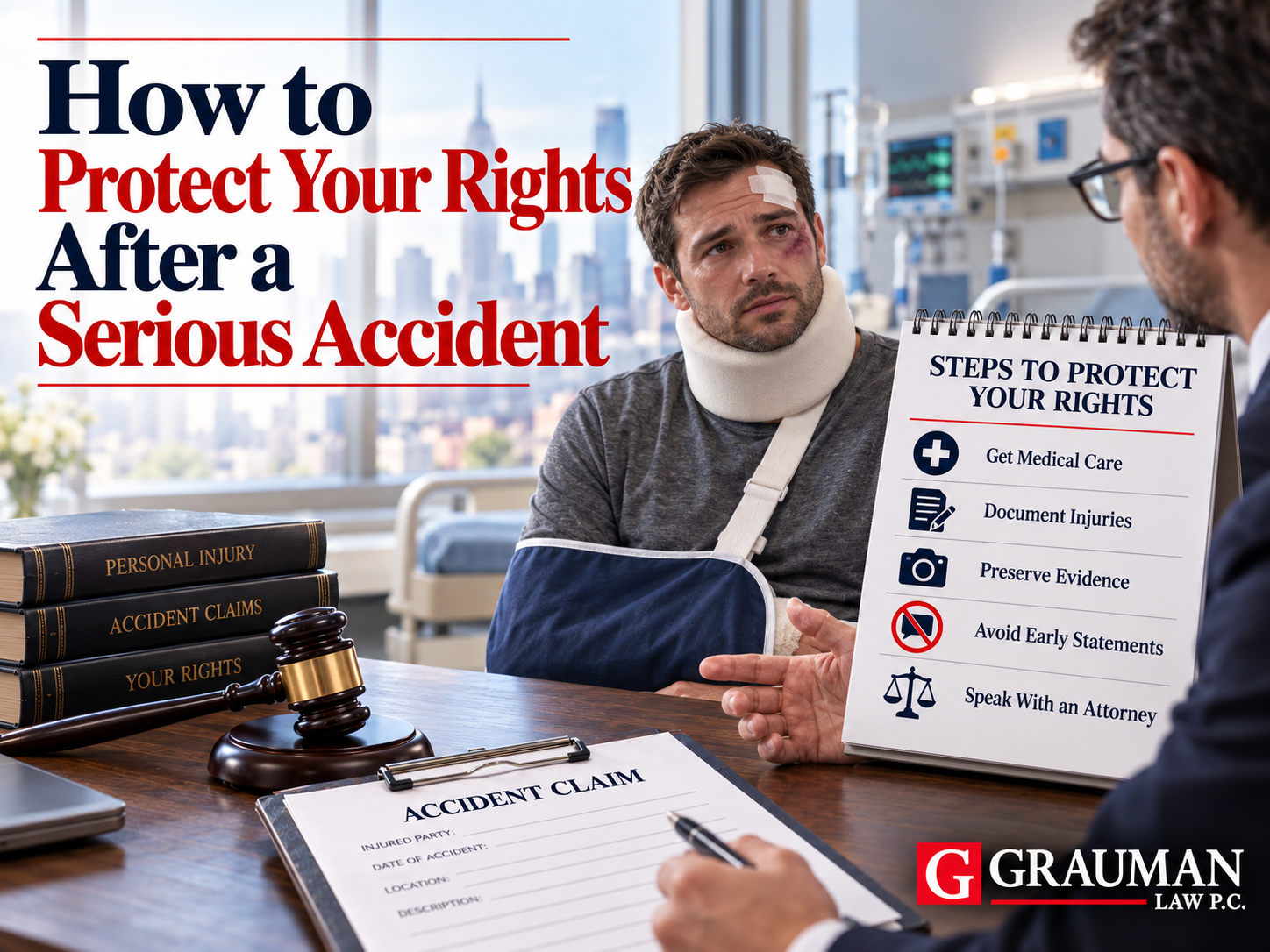
Grauman Law P.C. graphic showing an injured accident victim and steps to protect your rights after a serious accident

How to Protect Your Rights After a Serious Accident

In the days after serious car accidents here in Queens, victims typically start to have questions about their rights and how to protect them. Here's what you need to know. Protecting Your Rights After Car Accidents in Queens Stick to Your Medical Plan Follow every recommendation from your doctors and specialists, even if you start to think you're feeling better and would rather stop. Attend physical therapy, complete all prescribed tests, and report new or changing symptoms right away. This creates a medical record that clearly links your injuries to the crash, and it also protects you from unfair accusations (insurers like to challenge claims when the medical treatment stops and restarts). Start Keeping a Journal A simple daily journal is more effective evidence of what you've suffered than trying to talk about it all weeks or months later. Write down every day how much pain you felt, whether you had difficulty sleeping, any limitations you had with respect to work or chores, and the emotional effects of it all. This provides evidence that medical records and bills can't quantify. Get Organized Find and organize every piece of paper related to the crash, and act as quickly as you can. Create one folder for medical bills, insurance statements, prescription receipts, and visit summaries. Create another for your pay stubs or employer letters that show time you've missed from work. In a different file, include receipts for transportation to appointments, home modifications, or extra help around the house. Finally, keep a file with all communication you have with the insurance company and your lawyer. Watch What You Say to Insurers Notify your own insurer if you have not already done so, but limit your statements to just the basic facts. Always decline to give any recorded statements until you've talked to your lawyer, and never accept an early settlement offer without legal advice. Once you sign a release, you usually cannot reopen the claim even if it turns out that your damages are greater than you expected. Keep Evidence If your vehicle has not yet been repaired or sold, keep it intact so experts can examine it later. Request that any event data recorder information stay available. Get the information of any witnesses to your lawyer so your lawyer can confirm their willingness to speak, and give your lawyer all the information you have or remember about businesses or property owners near where the accident took place. Your lawyer can send a letter asking them to hold any surveillance video that may still exist. Don't Discuss Your Case Stay off social media when it comes to the crash or your recovery, and remember that any photos or comments that imply you're active can be taken out of context and used to argue that injuries aren't very serious. Do not discuss the details of the case with anyone except your doctors and legal counsel. Talk to a Lawyer Contact Grauman Law P.C. in Kew Gardens or Forest Hills as soon as possible to speak with a team that has over 50 years of experience representing the people of Queens and all of NYC.

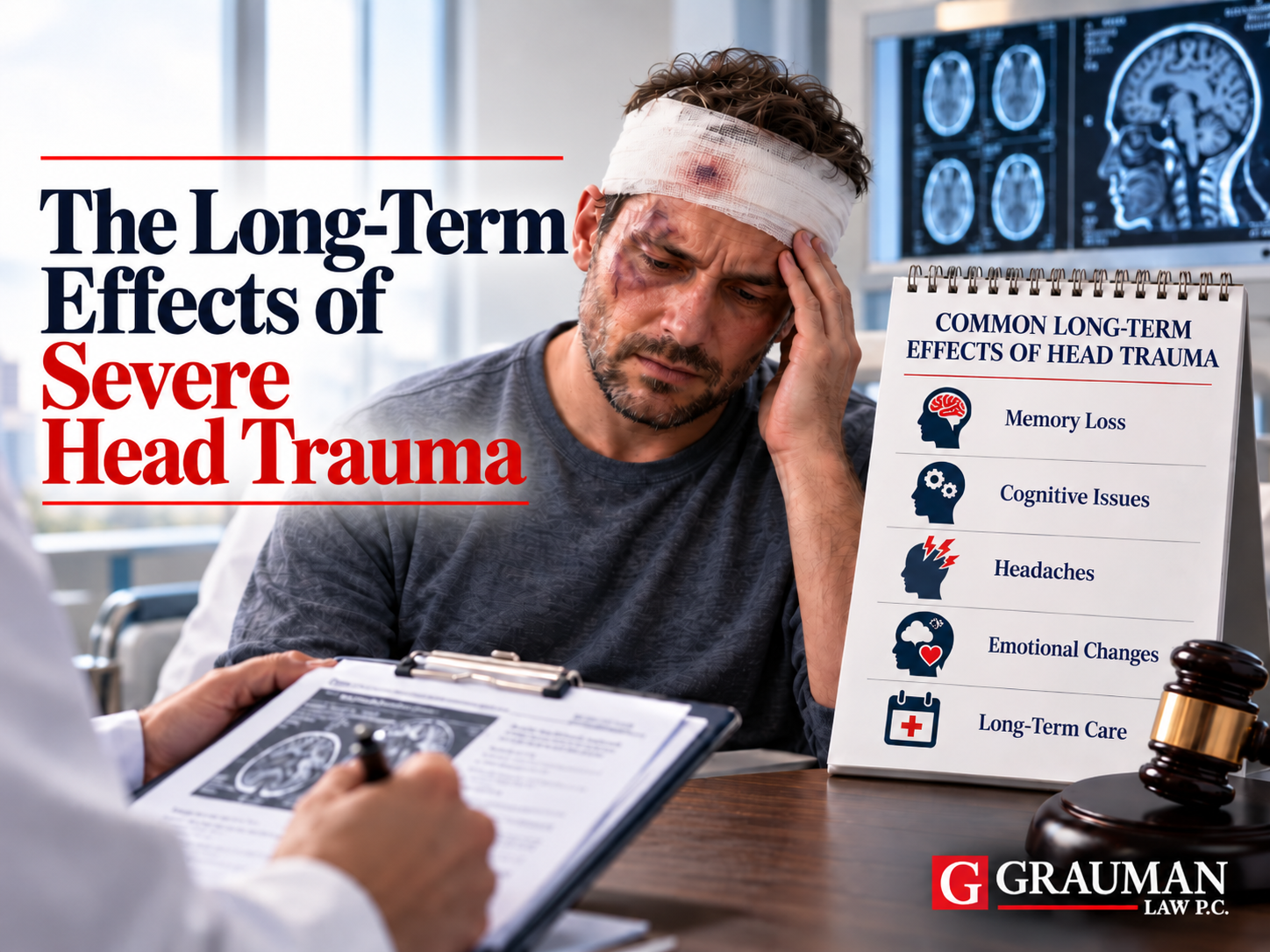
Grauman Law P.C. graphic showing an injured man with a head bandage and the long-term effects of severe head trauma

The Long-Term Effects of Severe Head Trauma

Severe head trauma after an accident can leave lasting effects on both the body and mind. Families in Nassau County who face a traumatic brain injury often have to deal with years of medical and daily life and work challenges. Traumatic Brain Injury Outcomes The first hours after a blow or jolt that damages brain tissue tend to dominate the medical attention, but the full cost of that injury frequently reveals itself only after the initial, acute crisis has passed. Five years after such an event, more than half of those still living remain moderately or severely disabled, and a similar share who once held jobs can no longer work. One in three still needs help with everyday tasks. Ability to Manage Life Memory, attention, processing speed, and the capacity to plan or shift from one task to another often remain impaired for a long time after these injuries, and cognitive change can be the most stubborn and far-reaching consequence. Studies that follow survivors for two years and beyond show that those with the gravest injuries fall further behind their peers on measures of general intellect and executive skill rather than catching up. Physical Complications Physical complications frequently persist as chronic conditions, like post-traumatic epilepsy (which appears in roughly 1/5th of survivors), balance problems, headaches, loss of smell or taste, visual disturbances, and sleep disruption. These are all common enough in survivors that they become chronic conditions rather than symptoms you can expect to improve with time. Hydrocephalus, infections, and damage to blood vessels that later raise stroke risk can all be present and add further complexity to the prognosis. Emotional Life Depression, anxiety, irritability, impulsivity, and reduced empathy appear in traumatic brain injury victims at rates well above those seen in the general population, and these often intensify rather than fade. An umbrella review of more than thirty million participants found elevated risks for psychotic disorders, attention-deficit conditions, suicide, and later dementia. These psychiatric and neurodegenerative associations often don't appear immediately, either. Hormonal Changes The pituitary gland sits at the base of the skull and is therefore vulnerable to impact. It can lose function after the injury, and that can mean hormonal disruption which worsens fatigue, muscle loss, cognitive fog, and emotional instability for years unless it is specifically tested for. Growth hormone deficiency is the most frequent finding, followed by shortages of sex hormones, thyroid hormone, and cortisol. Effects on Nassau County Victims and Families Because these injuries can continue to evolve rather than just resolve, families must arrange ongoing medical surveillance, rehabilitation, and practical support while they also plan for changing needs in housing, transportation, finances, and daily care. Legal questions about the proper compensation for all these costs over a lifetime can be heated and contested when the injury is due to the negligence of someone else. If you or someone close to you is living with the effects of severe head trauma, contact Grauman Law in Kew Gardens, NY for a free consultation. We've been serving Nassau County and New York City for nearly two decades.