
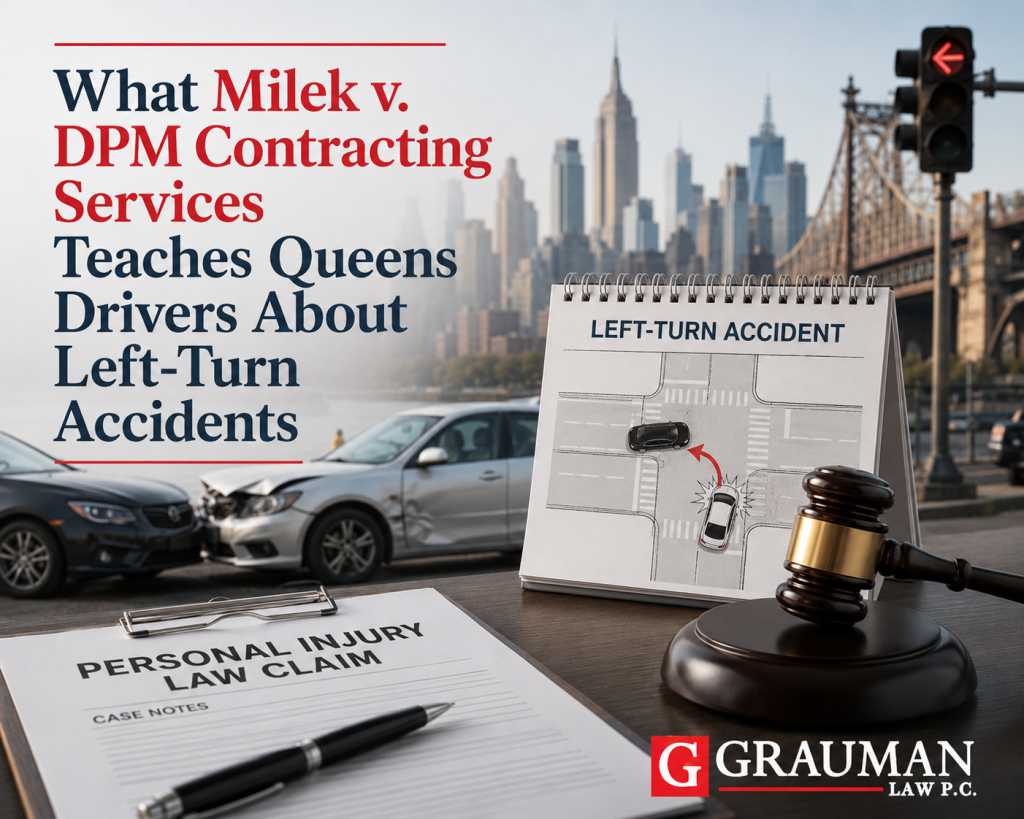
Left-turn accidents are among the most common causes of serious motor vehicle collisions in New York. When a driver turns left across oncoming traffic without yielding the right of way, the consequences can be devastating. A recent New York case, Milek v. DPM Contracting Services, Inc., demonstrates how courts analyze fault in these situations and why establishing liability is only one part of a successful personal injury claim.
For drivers in Queens, where busy intersections and heavy traffic create countless opportunities for left-turn collisions, this case offers important insight into how New York courts determine responsibility after an accident.
The Facts of the Case
In Milek v. DPM Contracting Services, Inc., the plaintiff sought summary judgment on the issue of liability following a motor vehicle accident. According to the plaintiff, he was traveling straight through an intersection when the defendant driver made a left turn directly into his path.
The plaintiff argued that the collision occurred because the defendant failed to yield the right of way before attempting the turn. Under New York law, drivers making left turns have a duty to ensure that the maneuver can be completed safely before crossing oncoming traffic.
The plaintiff moved for summary judgment, asking the court to determine that the defendants were legally responsible for causing the accident without the need for a trial on liability.
Why Left-Turning Drivers Face a Heavy Burden Under New York Law
New York Vehicle and Traffic Law places a significant responsibility on drivers who make left turns at intersections. A motorist intending to turn left must yield to approaching vehicles that are close enough to constitute an immediate hazard.
This rule exists because left turns are inherently dangerous. A driver crossing opposing lanes of travel must accurately judge the speed and distance of oncoming vehicles and wait until it is safe to proceed.
When a collision occurs during a left turn, courts frequently examine whether the turning driver failed to yield the right of way. If the evidence shows that the oncoming vehicle was lawfully proceeding through the intersection and had the right of way, the turning driver may be found negligent as a matter of law.
The Court’s Decision
The court granted summary judgment in favor of the plaintiff on the issue of liability.
A significant factor in the decision was the defendants’ failure to appear for depositions. Because the defendants did not provide testimony or evidence creating a factual dispute regarding how the accident occurred, they were unable to effectively challenge the plaintiff’s version of events.
Based on the evidence presented, the court concluded that the plaintiff established that he was traveling straight through the intersection when the defendant made an unsafe left turn into his path. As a result, the plaintiff successfully demonstrated entitlement to judgment on liability.
This meant that, for purposes of the lawsuit, the defendants were deemed legally responsible for causing the crash.
Why Winning on Liability Does Not End the Case
Many accident victims assume that proving another driver caused a crash automatically guarantees compensation. However, New York’s no-fault insurance system creates an additional hurdle for many injured plaintiffs.
Even after obtaining summary judgment on liability, the plaintiff in Milek still faced a separate legal issue: whether he sustained a “serious injury” under New York Insurance Law § 5102(d).
The serious injury threshold is a critical component of many New York car accident cases. To recover damages for pain and suffering, an injured person typically must demonstrate that their injuries satisfy one of the categories outlined in the statute.
Examples may include:
- Significant limitation of use of a body function or system;
- Permanent consequential limitation of use of a body organ or member;
- Fractures;
- Significant disfigurement; or
- Certain medically determined impairments that substantially interfere with daily activities.
Because liability and injury are separate legal issues, a plaintiff can successfully establish fault while still being required to prove that their injuries meet the statutory threshold.
Lessons for Queens Drivers
Queens is home to some of the busiest intersections in New York City. Areas along Queens Boulevard, Northern Boulevard, Woodhaven Boulevard, Hillside Avenue, and other heavily traveled roadways frequently see collisions involving left-turning vehicles.
The Milek decision reinforces several important principles:
Drivers Making Left Turns Must Yield
Motorists attempting a left turn cannot simply assume they have enough time to complete the maneuver. They must yield to oncoming vehicles that have the right of way and wait until the turn can be made safely.
Evidence Matters
The plaintiff was able to establish liability because the evidence supported his version of events and the defendants failed to present contrary evidence. Police reports, witness statements, photographs, surveillance footage, and deposition testimony can all play critical roles in determining fault.
Liability Is Only One Part of a Personal Injury Case
Even when fault appears clear, injured victims must still prove the extent of their injuries and, in many cases, satisfy New York’s serious injury threshold to recover non-economic damages.
Early Legal Action Can Help Preserve Important Evidence
After a left-turn accident, crucial evidence may disappear quickly. Surveillance footage may be overwritten, witnesses may become difficult to locate, and physical evidence can be lost. Prompt investigation can strengthen a victim’s ability to establish both liability and damages.
Conclusion
The decision in Milek v. DPM Contracting Services, Inc. serves as a reminder that drivers who make unsafe left turns can be held liable when they fail to yield the right of way to oncoming traffic. The case also highlights an important reality of New York personal injury litigation: proving fault is often only the first step.
For Queens drivers injured in a left-turn collision, understanding how courts analyze liability and serious injury claims can be critical when pursuing compensation. While every case depends on its unique facts, Milek demonstrates how clear evidence of an unsafe left turn can establish responsibility for a crash and position an injured victim to pursue recovery under New York law.


-
Kew Gardens Office
125-16 Queens Boulevard
Kew Gardens, NY 11415 -
Forest Hills Office
118-21 Queens Blvd #306
Forest Hills, NY 11375
The information on this website is for general information purposes only. Nothing on this site should be taken as legal advice for any individual case or situation. This information is not intended to create, and receipt or viewing does not constitute, an attorney-client relationship.